



A 4-week bootcamp accelerator is not a crash course in startup theory. It's a compression engine designed to move founders from their current reality to investor-readiness in 28 days. Each week builds on the last, and what you extract from it is in direct proportion to what you bring in.
The Structure: Why Four Weeks Works
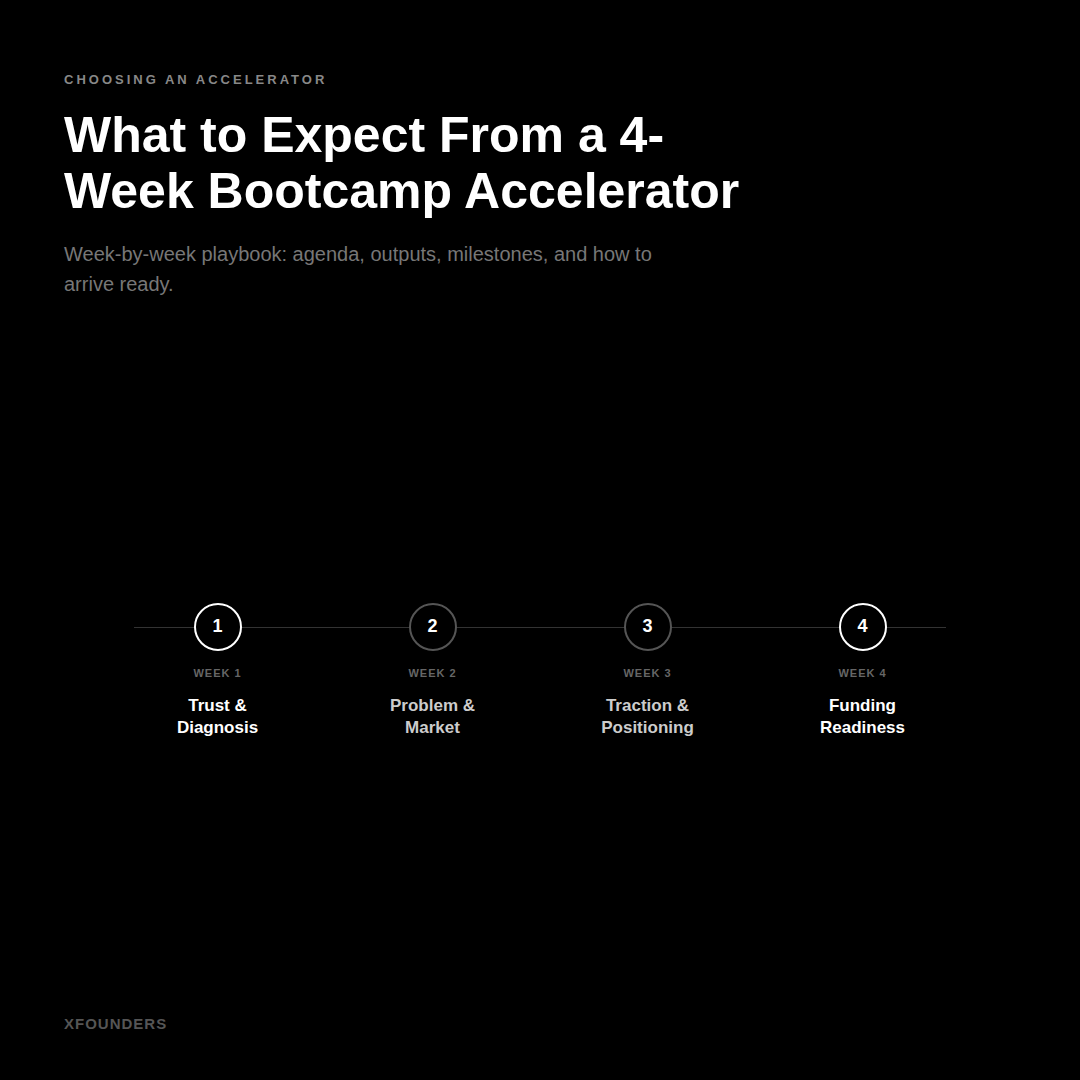
The logic behind the 4-week format is sequencing. Week one creates the foundation of trust and honest diagnosis. Week two applies that foundation to market and problem clarity. Week three builds the narrative and traction proof. Week four makes the ask.
Cut any week and the chain breaks. Skip the diagnosis and the pitch is built on assumptions. Skip the traction work and the investor conversations have nothing to land on. The compressed timeline forces decisions rather than deferring them. That pressure is the product.
Week 1: Trust and Diagnosis
What happens: Cohort integration, personal and company audits, identification of core assumptions, ecosystem mapping.
The first week is not about pitching. It is about establishing enough trust within the cohort and with the program that founders will say what is actually true rather than the polished version. Mentor sessions in week one are listening sessions. Mentors ask about founder background, motivation, and the real state of the company. They are not advising yet.
What you leave with: An honest articulation of where your company actually stands, a shared language with your cohort, and your development baseline established.
Milestone: Every founder has stated their real problem, not the investor-ready version.
Week 2: Problem and Market
What happens: Market sizing, customer discovery validation, competitive landscape analysis, business model stress-testing.
Week two challenges the assumptions you surfaced in week one. Domain experts in your market vertical run sessions designed to pressure-test rather than validate. This is where founders find out if their ICP is real, if their market size holds up to scrutiny, and if their business model survives contact with someone who knows the space.
What you leave with: Validated or invalidated core assumptions, a refined ICP, and a sharper articulation of the problem you're solving.
Milestone: You can clearly explain who your customer is, what pain you're solving, and why now. Your business model has been stress-tested at least once by someone outside your team.
Week 3: Traction and Positioning
What happens: Go-to-market strategy, metrics and KPI framework, narrative development, early partnership and customer conversations.
Week three is where the company turns outward. You move from diagnosis to proof, building a GTM plan with real channels, defining the metrics that matter, and developing the investor narrative from scratch. Mentor sessions shift to operators with GTM experience and investors giving early pitch feedback.
What you leave with: A GTM plan with defined channels, a metrics dashboard with targets, and a first version of your investor narrative.
Milestone: You have had at least one real customer or investor conversation during the program. Not a warm introduction. An actual conversation.
Week 4: Funding Readiness
What happens: Pitch refinement, investor matching, due diligence preparation, post-program roadmap.
Week four is about being ready to be evaluated. The pitch gets stress-tested by active investors. The data room foundation gets built. The 30-60-90 day post-graduation plan gets defined. Previous cohort founders come in to describe what fundraising actually looks like, not the narrative version but the reality.
What you leave with: An investor-ready deck, a data room foundation, a 30-60-90 day plan, and at least two warm investor introductions made through the program.
Milestone: You can deliver the pitch under pressure and answer hard questions without deflecting.
Step-by-Step: How to Get the Most from a 4-Week Bootcamp
- Know your numbers cold before you arrive. Revenue, users, burn, runway. Being vague on fundamentals in week one signals to mentors and cohort peers that you're not ready for the pace.
- Have a clear ask defined. Amount and use of funds. Founders who arrive without a clear ask spend week four catching up on work that should have been done before arrival.
- Know what you don't know. The program works best for founders who are honest about their gaps. Performing for the room is the fastest way to learn less.
- Prepare your founder story. Not just the company story, but why you specifically are the right person to build this. That answer gets tested early and often.
- Research your cohort before arriving. The peer network is as valuable as the mentors. Coming in knowing who's in the room accelerates the trust-building that week one depends on.
- Set one non-negotiable outcome for the four weeks. A specific funding conversation, a particular mentor introduction, a customer referral. Clarity of intent determines what you extract from the structure.
- Leave the ego at the door. Founders who expose their real problems get real solutions. Founders who perform for the room do not.
Concrete Examples
The founder who reframed the problem in week two A B2B SaaS founder entered confident in their ICP. Domain expert sessions revealed their target customer segment had a 6-month procurement cycle, making the 30-day close assumption structurally impossible. They pivoted to a prosumer market with a self-serve model. By week four, two pilots were running. Without the pressure of week two, that assumption would have survived into fundraising.
The pitch that changed in week three A Web3 infrastructure founder had a technically accurate pitch that no investor could follow. Narrative work in week three rebuilt the pitch around the problem being solved rather than the architecture of the solution. The same product, reframed. The investor sessions in week four generated two term sheet conversations.
The founder who arrived underprepared A founder arrived in week one without clean financials or a defined raise amount. They spent the first two weeks catching up to the cohort rather than compressing their development. The program still delivered value, but it delivered half of what it could have if they'd arrived ready.
Two Caveats
Works if you arrive with a product, early traction, and genuine honesty about your gaps. The compression mechanism works because there's something real to compress. Founders who need the program to find product-market fit get proportionally less from the structure than founders who need to accelerate toward it.
Avoid if you need longer than four weeks to validate your core hypothesis. The program will push you toward a funding narrative before your product can support it. A longer-form incubator or independent customer discovery work is the better prior step.
Want to improve the growth of your startup? Apply here
FAQ
Q: Is a 4-week accelerator enough time to make a real difference?
A: For founders who arrive ready, yes. The compression works because each week builds sequentially. The constraint is a feature. It forces decisions that a 12-week program lets you defer.
A: For founders who arrive ready, yes. The compression works because each week builds sequentially. The constraint is a feature. It forces decisions that a 12-week program lets you defer.
Q: What should I prepare before joining a bootcamp accelerator?
A: Clean financials, a clear funding ask, and an honest accounting of your company's gaps. The founders who get the most from the program are the ones who arrive prepared to be challenged rather than validated.
A: Clean financials, a clear funding ask, and an honest accounting of your company's gaps. The founders who get the most from the program are the ones who arrive prepared to be challenged rather than validated.
Q: How important is the cohort compared to the mentors?
A: Roughly equal in most cases. Peer accountability and peer learning are underrated variables in accelerator outcomes. Research your cohort before arriving and treat those relationships as seriously as mentor access.
A: Roughly equal in most cases. Peer accountability and peer learning are underrated variables in accelerator outcomes. Research your cohort before arriving and treat those relationships as seriously as mentor access.
Q: What happens after the 4 weeks?
A: The best programs maintain post-graduation support through investor introductions and community access. Ask the program specifically what the post-graduation relationship looks like before you commit.
A: The best programs maintain post-graduation support through investor introductions and community access. Ask the program specifically what the post-graduation relationship looks like before you commit.
Q: Can a founder join a bootcamp without being ready for investment?
A: Yes, but the program serves you less well. The week four funding readiness track is built for founders who've done the week two and three work. Arriving pre-traction means spending more time on fundamentals and less time on the track the program is designed for.
A: Yes, but the program serves you less well. The week four funding readiness track is built for founders who've done the week two and three work. Arriving pre-traction means spending more time on fundamentals and less time on the track the program is designed for.
