



How to Choose the Right Accelerator: 12 Criteria That Actually Matter
Choosing the wrong accelerator costs you equity and time you cannot recover. The right one compresses your path to funding and connects you to people who move your company forward. These 12 criteria separate programs worth your equity from ones worth skipping.
What Makes an Accelerator Different
An accelerator is a fixed-term, cohort-based program that combines capital, mentorship, and investor access within a compressed timeline, typically 8 to 16 weeks. That structure is the differentiator. Incubators offer longer runways with lighter guidance. Venture studios co-build and co-own. Grants give capital without equity or program. Angel and VC investors give capital and network, but not a structured development environment.
The accelerator's value is the compression. If you already have momentum, strong investor relationships, and a clear GTM, you may not need the program at all.
The 12 Criteria
1. Equity or Token Terms
Typical range: 2 to 10% equity, sometimes a token allocation in Web3. High equity above 8% demands proportionally stronger proof of value. Vague value propositions at high equity are a non-starter.
2. Mentor Network Quality and Relevance
Not the number of mentors listed. The relevance of their operational experience to your sector and stage. A list of 200 advisors is meaningless if none have built what you're building.
3. Portfolio Outcomes
Cohort size and total investment raised are not outcomes. Ask what percentage of portfolio companies raised follow-on funding within 12 months of graduation, and at what terms.
4. Investor Relationships and Demo Day Conversion
Demo day matters only if the right investors attend and decisions follow. Ask for specific examples of investor-founder matches made through the program, not just investors who showed up.
5. Stage Fit
Pre-product, pre-revenue, and pre-scale are different problems. An accelerator calibrated for pre-revenue companies will underserve a company already generating $500K ARR. Confirm the program's median portfolio stage before applying.
6. Sector Fit
Web3, AI, and fintech programs serve different founder profiles and mentor pools than generalist programs. Sector-specific programs offer more relevant mentorship and more targeted investor access.
7. Geographic Relevance and Market Access
The accelerator's network is geographically concentrated. A program with strong US investor relationships is less useful if your market is Southeast Asia. Understand where the program's relationships actually live.
8. Program Structure
In-person intensity drives cohort bonding and accountability. Remote flexibility enables participation across time zones and reduces disruption. Both work, but the right choice depends on your current operating model.
9. Post-Program Support
Most accelerator value is front-loaded. Programs that maintain active relationships with graduates through follow-on capital or continued community access deliver meaningfully more than those that end at demo day.
10. Cohort Quality
The peer cohort is an underrated variable. Founders learn as much from each other as from mentors. Ask about the selection criteria and profile of previous cohorts.
11. Reputation with Institutional Investors
Does the program carry signal weight with the VCs you want to reach? This varies significantly by geography, sector, and program generation. Research which investors have led rounds into portfolio companies.
12. Incentive Alignment
How does the accelerator make money if your startup fails? Programs compensated primarily through equity have stronger incentives to drive real outcomes than those running on sponsor revenue or application fees.
How to Evaluate: A Scoring Template
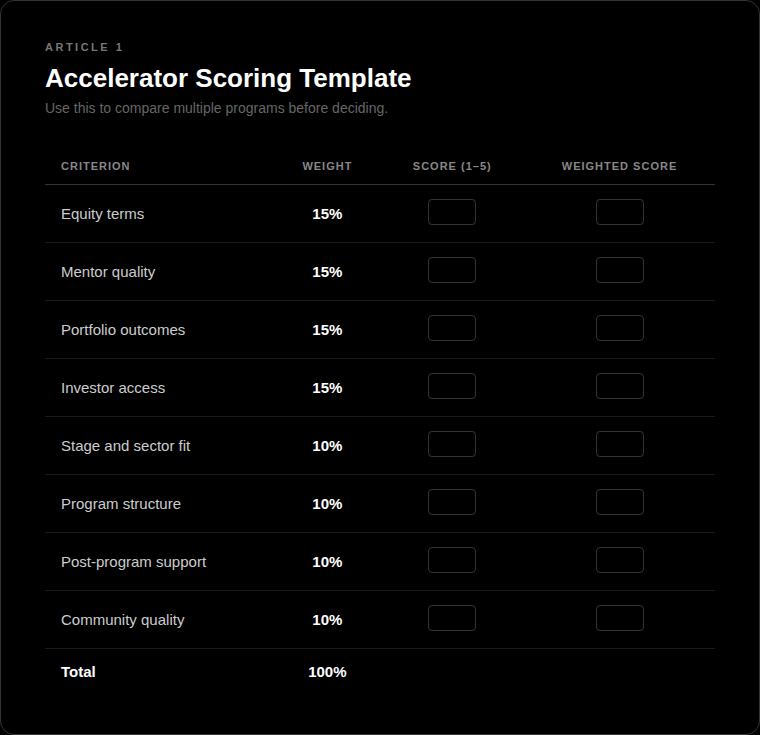
Use this to compare multiple programs before deciding.
How to Put Accelerators on the Spot: 6 Questions
Before signing anything, ask these directly. How a program answers tells you more than their pitch deck.
- What percentage of your portfolio raised follow-on funding, and within what timeframe?
- Name three portfolio founders I can call today, not ones you curated for reference.
- What happens to founders who don't fit the standard program track?
- How does your team make money if my startup fails?
- What does your team actually do week-to-week during the program?
- Who owns the investor relationships, your team or the founder?
Vague answers to questions 1 and 4 are the most reliable red flags.
Step-by-Step: How to Run Your Accelerator Selection Process
- Define your non-negotiable criteria first. Equity ceiling, sector relevance, geographic access. Set these before researching programs so you evaluate rather than react.
- Build a shortlist of 5 to 8 programs based on sector fit, stage fit, and geographic relevance. Use the scoring template above.
- Request outcome data from each program. Follow-on funding rates, timeline to funding, notable exits and failures. Programs that refuse are telling you something.
- Call portfolio founders from each program on your shortlist. Ask specifically about mentor quality, investor introductions made, and what the program didn't deliver.
- Score each program using the weighted template. Let the data narrow you to 2 or 3 finalists.
- Apply to your top choices simultaneously. Acceptance rates vary. Don't wait on one response before applying elsewhere.
- Use an acceptance offer as a negotiating anchor. Terms are sometimes negotiable, particularly equity percentage and token allocation in Web3 programs.
Concrete Examples
Y Combinator Strong on portfolio outcomes, investor access, and brand signal with US institutional investors. Equity terms at 7% for a standard SAFE are above average but justified by demo day conversion rates and alumni network effects. Stage fit skews toward early traction. Pure pre-product companies are less competitive applicants.
XFounders Bootcamp A 4-week in-person intensive designed for founders with early traction in Web3 and AI. High mentor relevance within the Solana and StarkWare ecosystems. Built for compression, for founders who need accountability and investor introductions within a specific sector window rather than a generalist 12-week program.
Techstars Strong geographic breadth and corporate partnership access. Value varies significantly by city program and managing director. Sector fit depends entirely on which Techstars vertical you apply to. The generalist programs are less differentiated than the sector-specific ones.
Two Caveats
Works if you have a product, early traction, and a clear funding ask. The compression works because you have something to compress. Founders who arrive without a clear hypothesis on customer or model get proportionally less from the structure.
Avoid if you're pre-product with a long development timeline ahead. An accelerator's fixed structure will push you toward a premature funding narrative before your product is ready to support it.
Want to improve the growth of your startup? Apply here
FAQ
Q: What equity percentage is standard for a startup accelerator?
A: Typically 2 to 10%. YC takes 7%. Web3-focused programs often negotiate token allocations alongside equity. Above 8% warrants strong justification from the program.
A: Typically 2 to 10%. YC takes 7%. Web3-focused programs often negotiate token allocations alongside equity. Above 8% warrants strong justification from the program.
Q: How do I know if an accelerator is a good fit for my stage?
A: Ask the program for the median stage of its recent cohorts. If most companies are post-revenue and you're pre-product, the cohort dynamic will work against you.
A: Ask the program for the median stage of its recent cohorts. If most companies are post-revenue and you're pre-product, the cohort dynamic will work against you.
Q: Is demo day the most important outcome of an accelerator?
A: It's one data point. More useful signals are the follow-on funding rate within 12 months, warm investor introductions made during the program, and what post-graduation support actually looks like.
A: It's one data point. More useful signals are the follow-on funding rate within 12 months, warm investor introductions made during the program, and what post-graduation support actually looks like.
Q: Can I negotiate accelerator terms?
A: Sometimes. Equity percentage and token allocation are occasionally negotiable, particularly with competing offers in hand. Program format is less flexible.
A: Sometimes. Equity percentage and token allocation are occasionally negotiable, particularly with competing offers in hand. Program format is less flexible.
Q: What's the biggest mistake founders make when choosing an accelerator?
A: Prioritizing brand recognition over fit. A well-known program in the wrong sector or at the wrong stage is less useful than a targeted program that connects you to the right investors and operators.
A: Prioritizing brand recognition over fit. A well-known program in the wrong sector or at the wrong stage is less useful than a targeted program that connects you to the right investors and operators.
